The Society for the Investigation of Spectral Phenomena
Mr. Quarrell's Bill for the Pit Passage
Theatre Royal, old theatre, Birmingham, West Midlands


I.Background & History
The Theatre Royal stood on New Street in Birmingham, a house of some two thousand seats, at first called the New Street Theatre, or colloquially the New Theatre. It was erected in 1774 and became a patent theatre by the Birmingham Theatre Act 1807, being known thereafter as the Theatre Royal.
The building was demolished in 1956. The Society holds no surviving plan of its passages and cellarage, and the particulars below rest on the account of a builder, not on any drawing of the fabric.
II.The Entity
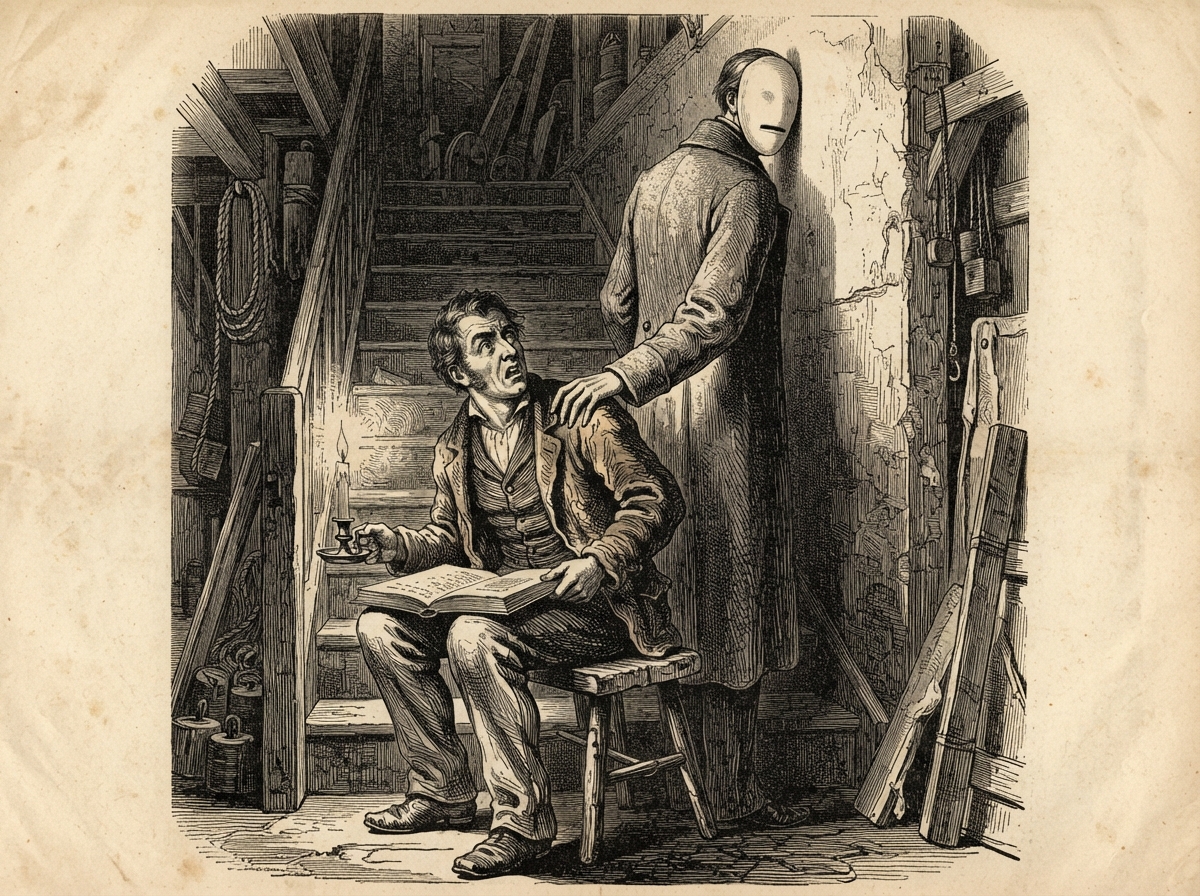
The Prompter's Echo
A tall figure in a dust-coloured greatcoat, seen only in the wings or the angle of a stair, its face turned permanently to the wall. It is said to speak in the voice of whoever last addressed it, and the voice is always a little behind the lips. Those who see it from the front report that the face is merely the pale plaster of the wall, with a mouth cut in it.
Assessment of Peril
Class IV: Malignant
The Echo repeats to the living the private matters they have told no one, and three persons who answered it were found dead in rooms they had no reason to enter. It has shown a marked interest in anyone who writes down what it says.
III.The Account
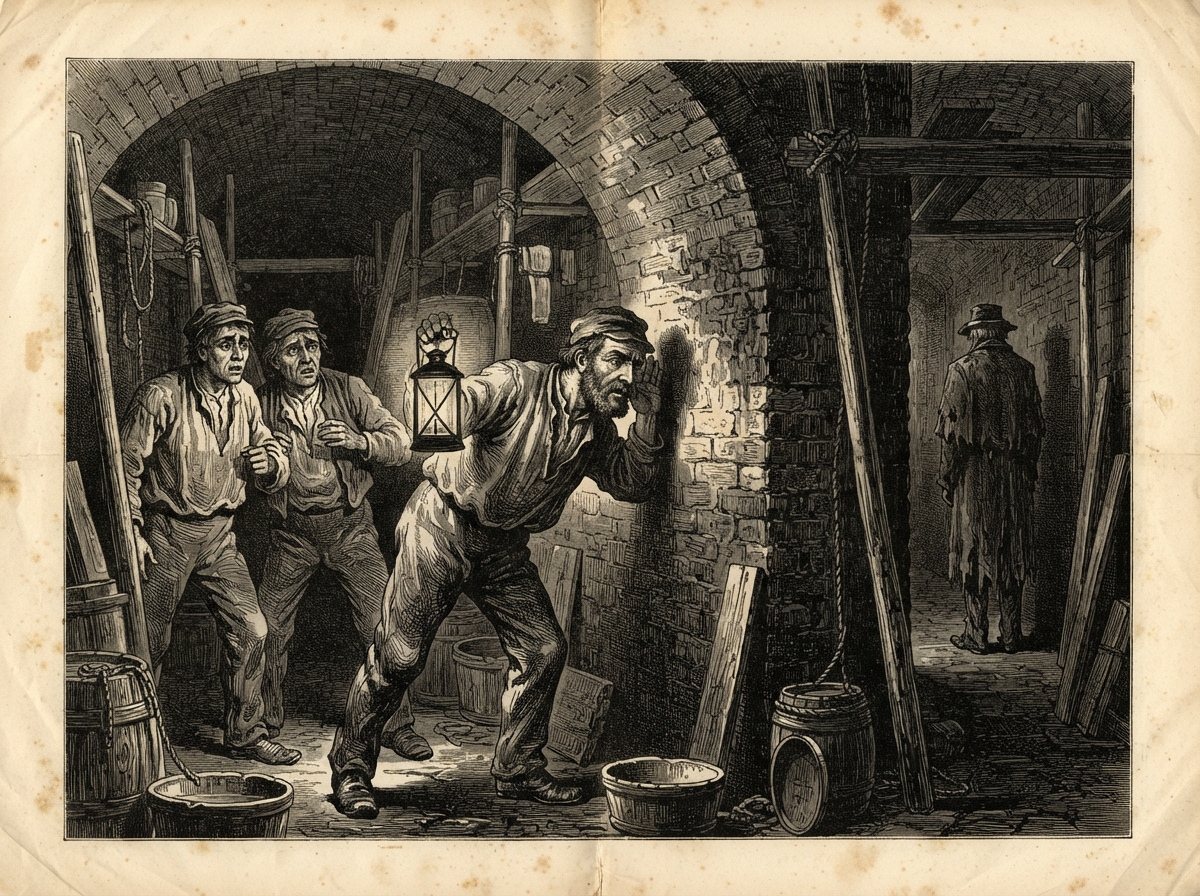
The following is extracted from the bill and day-book of Mr. Josiah Quarrell, master builder, who was engaged in the autumn of 1776, two years after the theatre was raised, to mend the plaster and brickwork of the pit passage, where the damp had lifted the lime from the wall. His entries are of the plainest kind: so many labourers, so many bushels of hair for the plaster, so many days lost to rain. The first oddity appears on the ninth day, when a labourer named Tolley, tapping the wall for a sound place, struck a hollow and was answered. Mr. Quarrell writes that it was a knock in reply, 'very civil, as a man might knock to a man.'
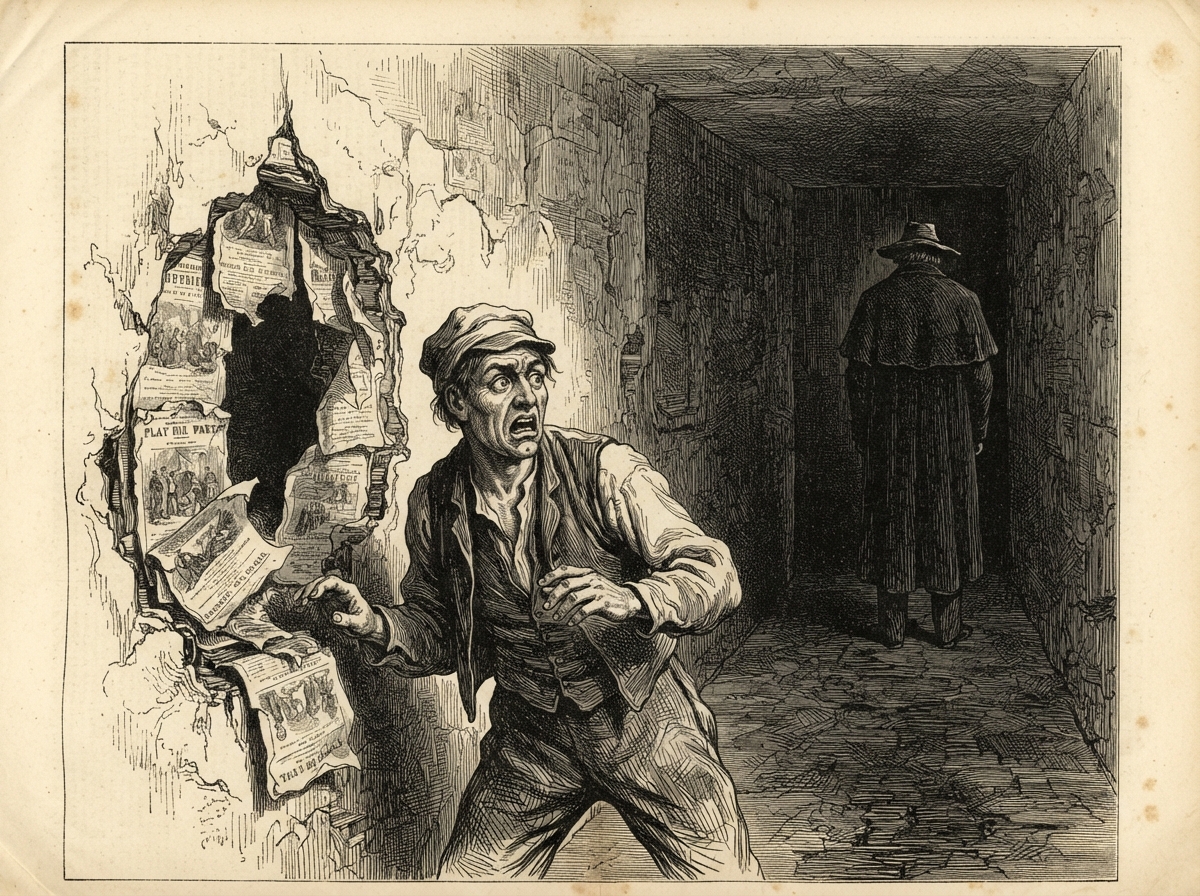
On opening the wall the men found nothing, no bricked-up cavity and no bones, only a flat space the width of a person, lined with old playbills so thickly pasted that they had become a kind of board. Tolley, the day after, asked the wall in jest who was within. The wall replied in his own voice, and spoke of a sum he had taken from his mother's tin and a child in Digbeth whom he had not owned. Tolley left the work that hour. The bill records 'one hand less' and nothing further, though a later line, in another ink, notes that he was taken from the canal at Gas Street with his eyes open.
The remaining men would not speak to the wall, but the wall had begun to speak to them. It addressed Mr. Quarrell's foreman through the lath at night in the voice of his wife, three years dead, and told him which of his children he had never loved. It knew the numbers of debts. It knew where a plasterer had hidden a pawn ticket. Mr. Quarrell, a sensible man, entered each remark in his book, and observes with some pride that he 'did not answer, nor suffer any to answer.' He also observes, a few pages on, that the voice had begun to quote his own entries to him before he wrote them.
IV.Recorded Manifestations
- ✦A courteous knocking within the plaster of the pit passage, which answers any knock struck upon it
- ✦Speech in the voice of the listener's own dead, reciting debts, hidden objects and unspoken sins
- ✦A cold dust, smelling of lime and burnt tallow, on the shoulders of anyone who has spoken to it
- ✦Handwriting in ledgers that repeats a clerk's entries a day before he makes them
- ✦A shallow brow-shaped mark in fresh plaster, at the height of a tall man's face
Testimony of Witnesses
“I was sent for the book and a gentleman in a grey coat stood facing the wall by the pit door. I said 'Sir,' and he said 'Sir' in my voice, and then he said my mother's name, and she was in Coventry.”
“I never answer a knock in that passage. My sister did, and the wall told her which of her babes would not see Christmas. It was right.”
“A scene-shifter was brought to me insisting that the brickwork had repeated a conversation he had held alone in a privy. I thought him unwell. I have since had occasion to speak to a wall myself.”
V.Rite of Expulsion
Difficulty: Perilous
Requisites
- ☐A tallow candle, unlit until the rite begins
- ☐A sheet of unmarked paper
- ☐A bowl of clean water
- ☐A cloth to cover the mouth
- ☐A lump of chalk
The Rite
- I.1. Enter the passage at the ninth hour of the night and speak to no one.
- II.2. Draw a chalk line across the floor, a yard from the wall, and stand behind it.
- III.3. Cover the mouth with the cloth and strike the wall once with the knuckle.
- IV.4. When the wall answers, do not reply, but pour the water slowly at the foot of the line.
- V.5. Light the candle and hold the blank paper before it until the voice falls silent.
- VI.6. Leave backwards, still silent, and burn the paper in the open air before dawn.
Caution. Whoever speaks at any point in the rite must be considered answered. The Society's Mr. Hollin replied to his dead brother's voice in 1894, and was found at the foot of the same stair, to which he had no reason to go.
VI.Hauntings of the Surrounding District
Select a bar to filter the register.
Old Joint Stock Theatre · Old Theatre · 0.1 miles
The Shareholders' Cortège, phantom procession. On the nights of annual meeting, a silent file of men in black stocks descends the stair, and each of them wears the face of whoever watches.
Hall of Memory · Manor House · 0.3 miles
The Cenotaph Sentry, revenant. A soldier in a sodden greatcoat stands within the colonnade at dusk, and answers the roll-call of names that no one has called.
St Philip's Cathedral · Church · 0.1 miles
The Pew-Opener's Bride, white lady. A pale woman in a veil sits in the gallery during empty services, and the pews beside her are found warm.
Birmingham and Midland Skin and Urinary Hospital · Hospital · 0.2 miles
The Night Dresser, possession. A nurse who sleeps in the old ward wakes speaking the symptoms of patients dead a century, in a voice not her own.
Severn Street Synagogue · Manor House · 0.2 miles
The Cantor of Severn Street, spectre. A thin voice sings from the shuttered hall at dusk, and those who listen are found to know the words.
The Alexandra · Old Theatre · 0.2 miles
The Flyman's Hand, poltergeist. Ropes run through the grid by themselves in the dark, and every rehearsal ends with one seat dragged to the centre of the stage.
The Old Rep · Old Theatre · 0.2 miles
The Greasepaint Cat, spectral animal. A white cat with a painted human mouth sits in the dressing-room mirror, and is there when no cat is in the room.
St Jude's Church · Church · 0.2 miles
The Burial-Ground Beadle, headless apparition. A staff-bearing figure walks the old paths in the fog, and the lamp it carries burns where its head should be.
Birmingham Repertory Theatre · Old Theatre · 0.4 miles
The Cue-Light Child, unclassified entity. A small green glow dims and brightens in the flies, and the actor who obeys it does not leave the stage again.
Big Brum · Old Tower · 0.2 miles
The Clockface Spark, will-o'-the-wisp. A pale flame crosses the tower dial at midnight, and the hands are found an hour wrong at morning.
Golden Eagle · Old Inn · a few paces
The Tap-Room Cur, phantom hound. A lean black dog lies beneath the settle after closing, and its eyes follow whoever is next to die.
Trocadero · Old Inn · a few paces
The Cloak-Room Dancer, revenant. A man in evening dress waltzes alone in the empty hall, and his partner's footprints appear in the dust.
Alpha Tower · Old Tower · 0.3 miles
The Lift-Shaft Clerk, spectre. A grey figure rides the cable at night, stopping at floors where no button has been pressed.
The Crown · Old Inn · 0.2 miles
The Cellarman's Cough, poltergeist. A dry cough follows the landlord up the stair, and glasses are set in rows upon the bar before he wakes.
BT Tower · Old Tower · 0.3 miles
The Wire Choir, phantom procession. At dead of night a murmuring crowd is heard in the mast's humming, each voice speaking a number belonging to a living house.