The Society for the Investigation of Spectral Phenomena
Private Papers of a Curate on the Priory Lilies
Prittlewell Priory, abbey, Leigh on Sea, Essex


I.Background & History
Prittlewell Priory stands in the Prittlewell district of Southend, Essex, and was founded in the twelfth century by monks of the Cluniac Priory of St Pancras at Lewes in East Sussex. At the dissolution of the monasteries under Henry VIII it passed into private hands, and it remained so for centuries, latterly with the Scratton family.
The jeweller and philanthropist R. A. Jones bought the Priory from the Scratton family and gave it, with its grounds, to the local council. The grounds were opened as Priory Park, and the Grade I listed building became the first museum in Southend. The remains of the priory are a scheduled monument.
Source: Prittlewell Priory, Wikipedia
II.The Entity
The Lily-Reeve
A tall figure in the stained grey habit of a Cluniac lay-brother, its face always turned from the beholder, so that only the tonsured crown and a sagging sleeve are seen. Cut lilies hang from its folded hands, though it is never seen to carry them in, and their petals are the yellow of old tallow. Those who have looked on it from the front, and none have lived to say it plainly, are reported to have found the face the same as their own, only older.
Assessment of Peril
Class IV: Malignant
Every death in its record was preceded by the scent of lilies, and each recorded instance was stronger than the last. No person who has smelled it indoors has survived the quarter.
III.The Account
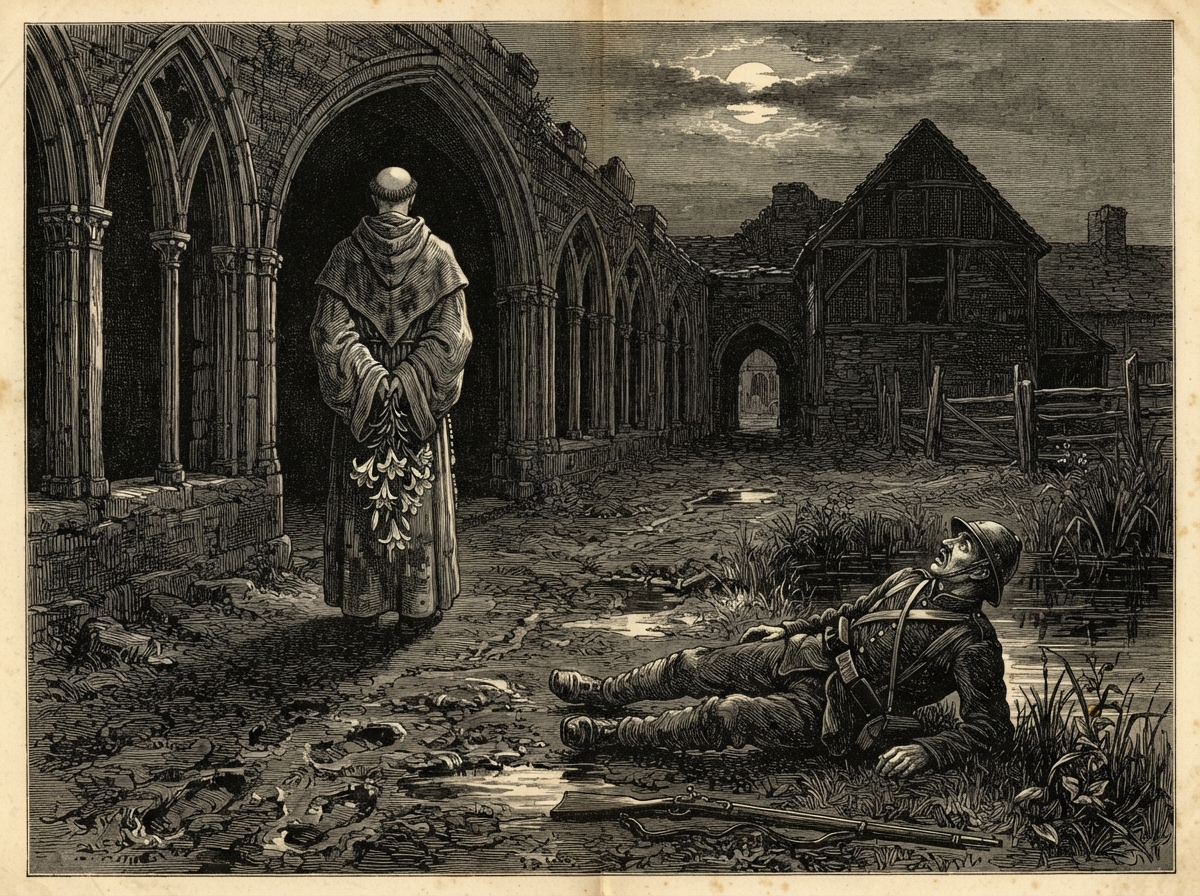
The Reverend Mr. Josiah Fenn, curate of a parish near Prittlewell, left a bundle of papers in which his sermons are interleaved with private jottings. The first, dated the autumn of 1643, concerns the Parliament's soldiers quartered in the old Priory buildings, then a private house and farm. He writes that a trooper named Hale was found at the fishpond with his eyes open, and that the whole yard had smelled that morning of lilies, though it was October and nothing flowered. 'I preached on the lilies of the field,' he writes, 'and was ashamed of my text before I had finished it.'
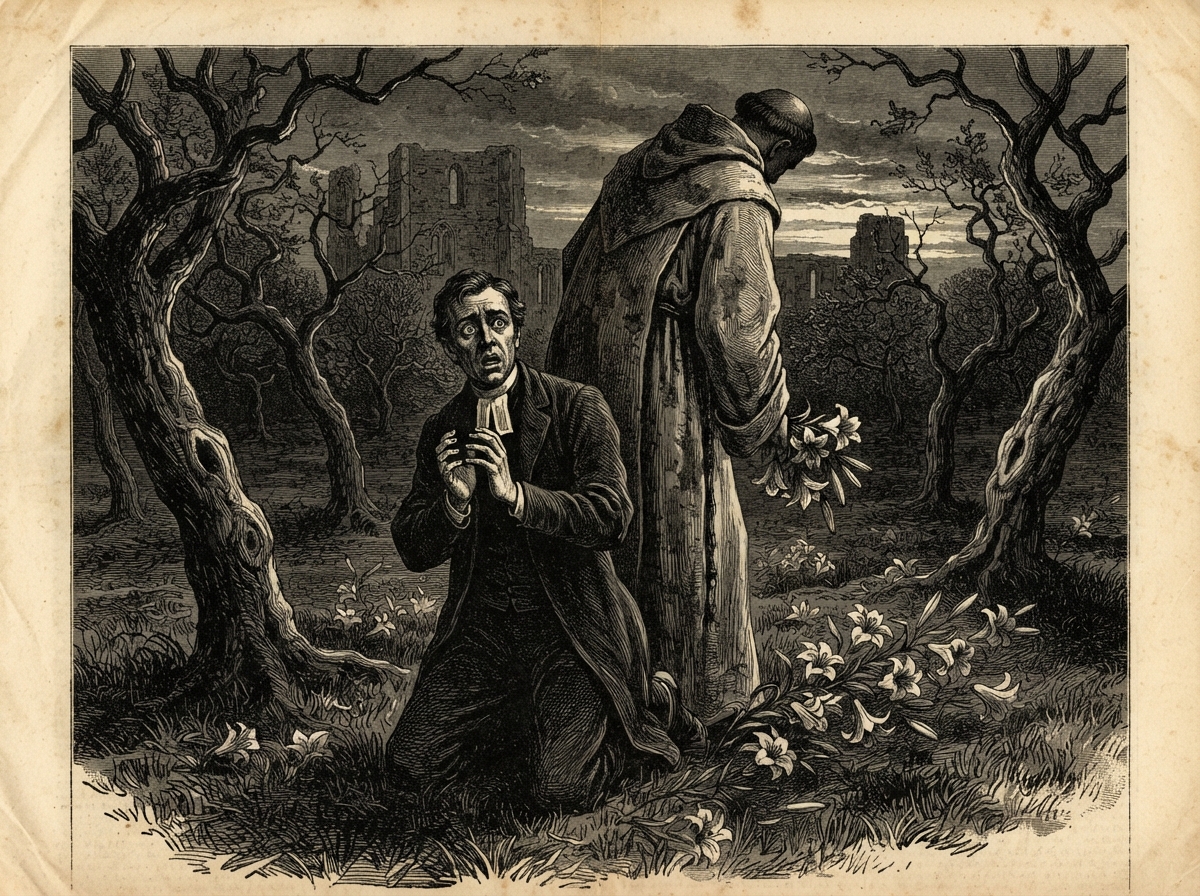
By the winter the smell had come twice more, and twice more a man was carried out. Fenn notes that the odour is stronger at each coming, at first a sweetness at the edge of the nose, then a thickness like a hand across the mouth. He questions the soldiers and records that every one who smelled it saw a lay-brother in grey at the end of the cloister walk, always going away. His hand, in the margin, becomes less steady. 'I have said from the pulpit that this is fancy. I do not now say so.'
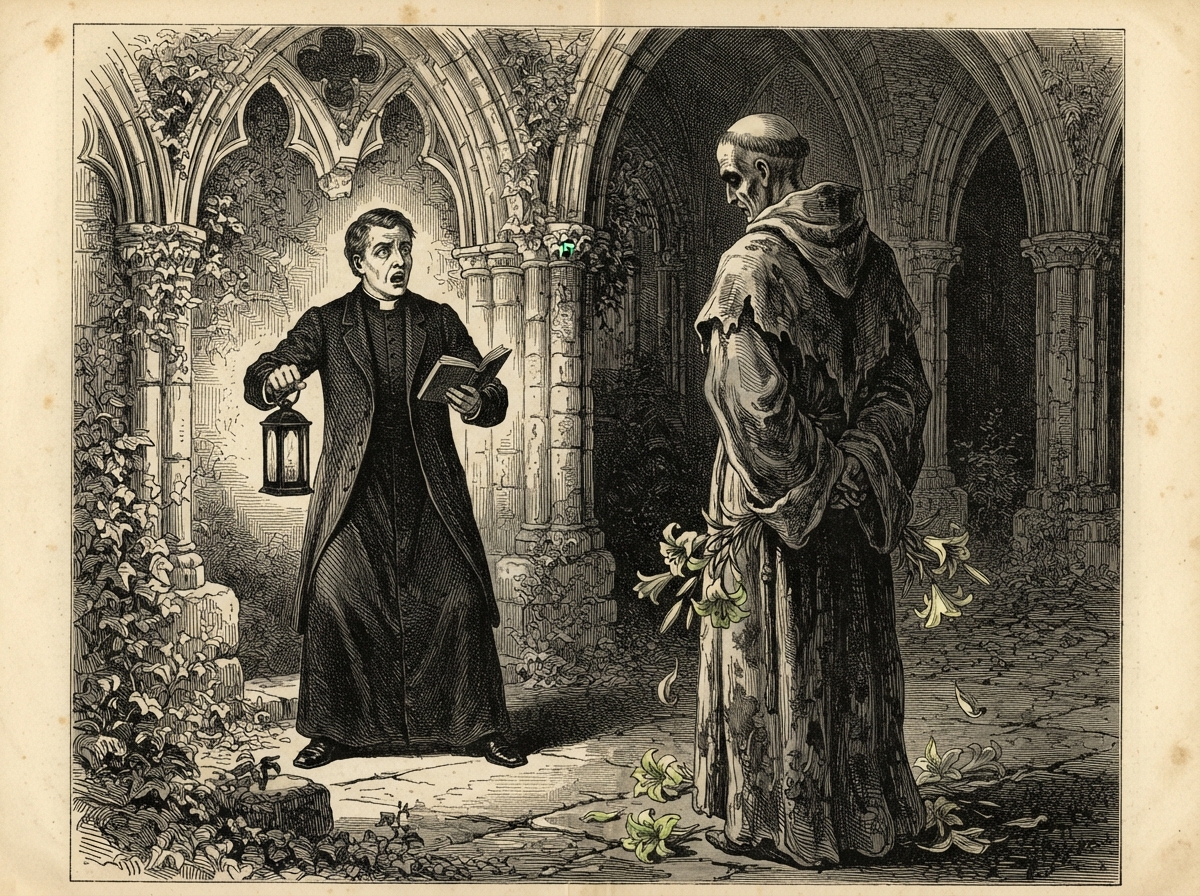
In the spring of 1644 he walked the ruined range himself, with a lantern and the Prayer Book. The notes for that night are broken. He writes that the lilies were so strong in the dark that he wept without grief, and that the figure stood in the old chapter-ground with its back to him, holding the blooms against its chest. He set down that he spoke the office for the dead over it, and that it turned its head a little, as one does who has been named. Beneath this the page has been struck through three times, and the words beneath may be read: 'It knew my voice.'
IV.Recorded Manifestations
- ✦A scent of lilies, sweet and then suffocating, in rooms where no flowers have been placed, preceding a death by up to three days.
- ✦Each occurrence is stronger than the last, so that the most recent were detected in the street outside.
- ✦A grey figure at the end of a passage or walk, always retreating, never approached.
- ✦Petals the colour of old tallow found on thresholds, dry as paper, which crumble to a grey dust at the touch.
- ✦Persons who have smelled the scent report that their own voice sounds slightly older when they speak.
Testimony of Witnesses
“"The dairymaid said the dairy smelt like a coffin-house, and by Thursday she was in one. I would not go into that yard again without my dog, and the dog would not go either."”
“"I was called to a child who had sickened with no cause I could find. The room was full of lilies, though the sill was bare. I did my best, and I am no longer a man who says it was the drains."”
“"I had the long gallery to do, and a lady in the corner said the flowers were too heavy. There were no flowers, sir. I give my notice from that day."”
V.Rite of Expulsion
Difficulty: Perilous
Requisites
- ☐A Book of Common Prayer of the 1662 pattern
- ☐One white candle of tallow, unscented
- ☐A bowl of cold well-water
- ☐A handful of dry salt
- ☐A grey woollen cloth, clean and unmarked
The Rite
- I.Begin at the stroke of three in the afternoon, with all windows closed and no flower in the building.
- II.Set the candle at the east end of the chapter-ground and the bowl of water at the west.
- III.Read the Order for the Burial of the Dead aloud, omitting the name of any living person.
- IV.When the scent rises, do not speak and do not turn about, however near the sound of footsteps.
- V.Cast the salt upon the water and cover the bowl with the grey cloth.
- VI.Extinguish the candle between finger and thumb, and leave by the way you came without looking back.
Caution. The Society's officer Mr. Ames spoke the name of the rector during the third step in 1889, and was found at the cloister arch with his eyes open. Not one of his papers was legible after.
VI.Hauntings of the Surrounding District
Select a bar to filter the register.
St Laurence and All Saints Church · Church · 1.3 miles
The Chancel Mourner, spectre. A veiled figure kneels at the rail on winter evenings, and those who approach find the cushion wet and cold as a drowned man's coat.
Rochford Hall · Manor House · 1.9 miles
The Hall Bride of Rayleigh Lane, white lady. She is seen in a gown of yellowed lace at the upper window, and each time the window is found open and the room unchanged.
St Mary's Church · Church · 0.3 miles
The Lantern-Bearers of Prittle Brook, phantom procession. Six hooded figures cross the churchyard at dusk with a bier, and the sexton has never counted more than five on their return.
Palace Theatre · Old Theatre · 0.8 miles
The Gallery Knocker, poltergeist. Rapping rises from beneath the empty stalls, and on one night in each year the seats are found turned toward the stage.
St Mary and All Saints · Church · 2.4 miles
The Glebe Gleaner, revenant. A stooped man in a smock is seen at the edge of the churchyard, bending to gather what is not there, and he is always nearer at the second look.
Our Lady Help of Christians and St Helen's Church · Church · 1.1 miles
The Candle-Eyed Ewe, spectral animal. A white sheep stands at the porch at midnight, and its eyes burn with the steady light of altar tapers.
Cliff Town Congregational Church · Church · 1.2 miles
The Borrowed Precentor, possession. A congregant is said to rise unbidden and sing in a deep strange voice a hymn which was never printed.
Cliffs Pavilion · Old Theatre · 1.3 miles
The Pavilion Hush, unclassified entity. In the empty auditorium a silence gathers so complete that one hears one's own pulse answered from the stalls.
New Empire Theatre · Old Theatre · 1.3 miles
The Limelight Tenor, headless apparition. A man in evening dress is seen in the flies, singing without a head, and the notes come from where his face should be.
Southchurch · Church · 1.6 miles
The Creek-Side Shuck, phantom hound. A black dog trots along the sea wall before storms, and its footprints fill with water that is never salt.
Southchurch Hall · Church · 1.5 miles
The Moat Taper, will-o'-the-wisp. A pale flame drifts above the old moat, and those who follow it are said to be found with their lamps still burning.
St Clement's Church · Church · 2.3 miles
The Rood-Loft Whisperer, spectre. A voice speaks the names of the parish's unborn from the dark above the chancel arch.
The Railway Hotel · Old Inn · 1.2 miles
The Platform Porter, poltergeist. Luggage is moved in the small hours by unseen hands, and a bell rings for a train that was cancelled before any living clerk was hired.